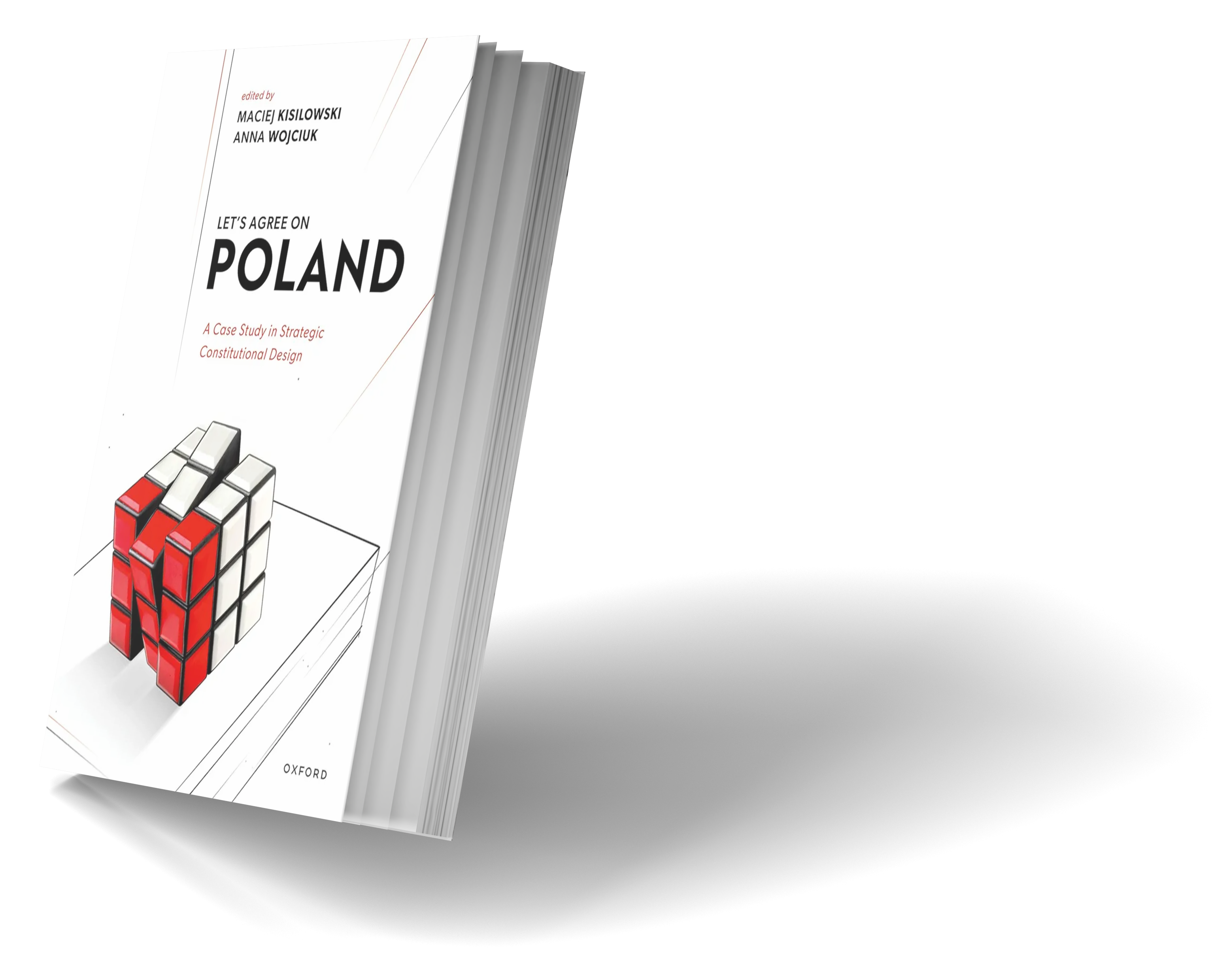
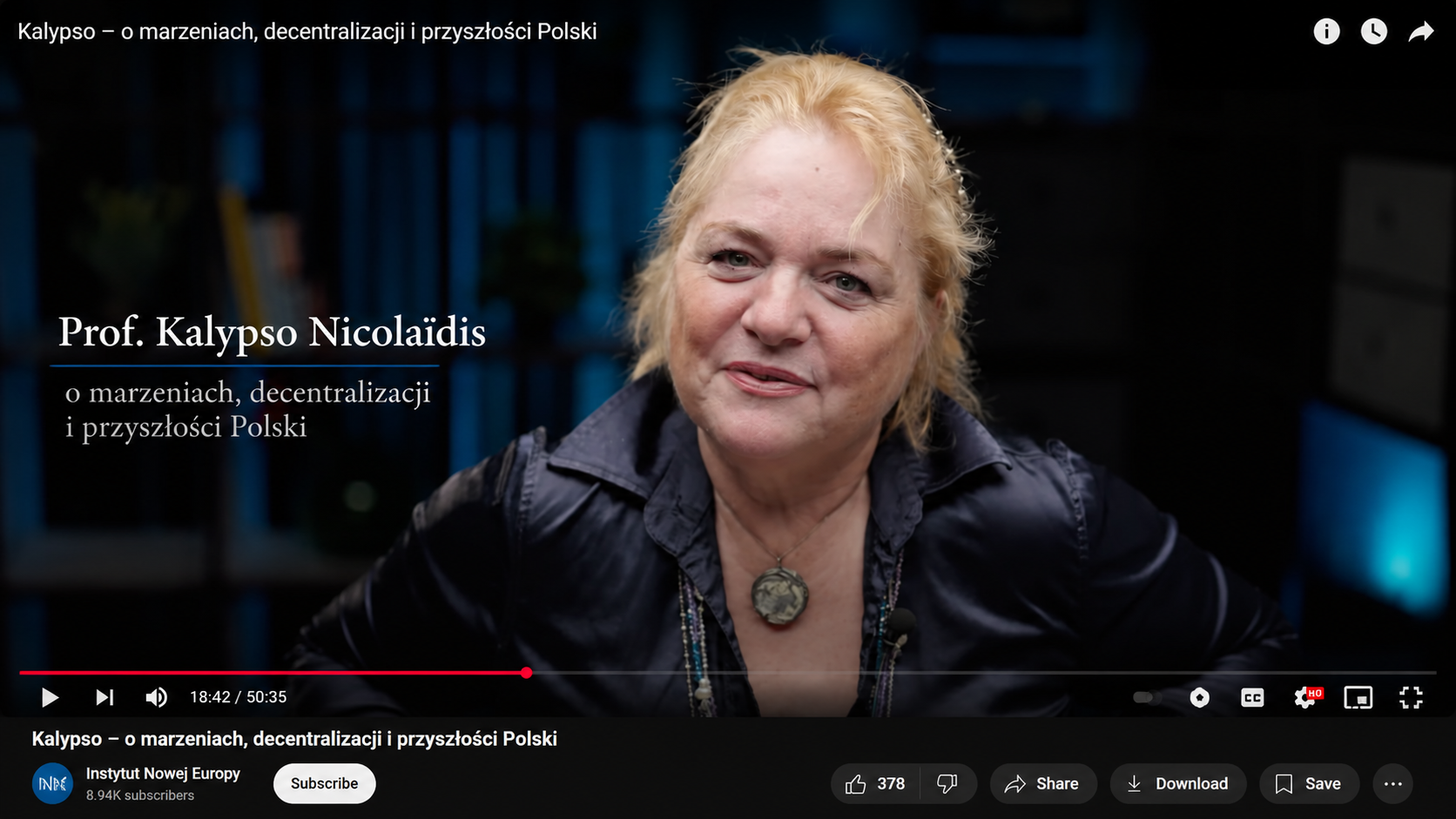
Disinformation and manipulated media environments threaten the integrity of democratic processes and the legitimacy of constitutional orders. This panel probes whether structural design—rooted in a cross-ideological contractarian approach—can shield constitutional processes from manipulation without sacrificing free speech or pluralism. Building on Let’s Agree on Poland: A Case Study of Constitutional Design (Oxford University Press, 2025), […]
Read more
#LetsAgree book discussion will take place at the Annual Congress of the International Society of Public Law (ICON-S) in Dublin. The panel will take place in the very first slot of the Congress and will feature a world-class group of constitutional lawyers discussing the broader implications of the Let’s Agree on Poland project. Monday, 29 […]
Read more
Poland’s judicial crisis illustrates how constitutional institutions become battlegrounds in a deeply polarized society. As argued in Let’s Agree on Poland, the conflict is driven not only by legal disputes but by competing visions of the state, each seeking to secure its values through control of the courts. This panel, Round Table Approaches to Judicial […]
Read more
Over the past decade, Poland has become one of Europe’s most polarized democracies. Conflicts over institutions, identity, religion, and cultural values have increasingly challenged democratic cooperation. In response, the Social Contract Incubator (IUS)—a network of 130 Polish intellectuals from across ideological divides—launched a unique effort to explore whether a deeply divided society can develop common […]
Read more
Institutional design for deeply divided societies requires frameworks that stabilize political competition without demanding social consensus. Drawing on the model developed in Let’s Agree on Poland, this approach treats polarization as a structural and durable cleavage, not a temporary pathology. The central claim is that when ideological or identity groups are territorially clustered, and majority […]
Read more
Can storytelling help address the democratic crisis? Let’s Agree on Poland: A Case Study of Constitutional Design(Oxford University Press, 2025) responds with an audacious “yes.” The book — the product of nearly a decade of cross-partisan collaboration among 130 Polish intellectuals — is anchored in rigorous constitutional design. Yet it also ventures into new territory […]
Read more
A discussion with Prof. Adam Czarnota on mobilizing society and the political system for constitutional reform aimed at countering the destructive tendencies of contemporary populism. Drawing on the Polish experience, the conversation will address the role of legal expertise in social transformations, the ways in which NGOs facilitate constitutional change, and the prospects for a […]
Read more
Too often, democratic debate reduces opponents to caricatures. Let’s Agree on Poland: A Case Study of Constitutional Design (Oxford University Press, 2025) — the product of the Social Contract Incubator (IUS), an association of 130 Polish intellectuals spanning the left to the conservative right — insists on a different approach: distinguishing moral legitimacy from democratic […]
Read more
This is an in-person event requiring registration at: https://www.eventbrite.com/e/after-consensus-decentralisation-as-the-future-of-democratic-governance-tickets-1987309090988 Polarisation is tearing democracies apart and few European countries illustrate this more starkly than Poland. In the book Let’s Agree on Poland (Oxford University Press, 2025) a group of leading Polish thinkers, from the left to the hard right, argues that as political preferences increasingly follow […]
Read more
Constitutional Remedies to Democratic Backsliding: Institutional Protection and Polarisation Management in „Let’s Agree on Poland”
Read more
Across Europe and beyond, political polarization has become a defining challenge of democratic life. Yet the debate often overlooks a structural driver of division: the concentration of power at the national level. Let’s Agree on Poland: A Case Study of Constitutional Design (Oxford University Press, 2025) — the outcome of a decade-long collaboration among 130 […]
Read more
Across Europe, political conflicts increasingly appear entrenched and mutually incomprehensible. In Poland, the long-running confrontation between progressive and conservative political camps has strained institutions and public trust. In Spain, tensions surrounding territorial autonomy, constitutional reform, and the Catalan independence movement have likewise revealed the limits of conventional political discourse. This panel will explore whether storytelling […]
Read more
For over a decade, Poland’s battles over the judiciary have been cast internationally as a moralized struggle between good and evil. Let’s Agree on Poland: A Case Study of Constitutional Design (Oxford University Press, 2025), a Polish constitutional bestseller now available in English, takes a different approach. Written by 28 expert co-authors drawn from the […]
Read more
This seminar explores the creation and core arguments of Let’s Agree on Poland. A Case Study in Strategic Constitutional Design (Oxford University Press, 2025) as a real-world negotiation experiment conducted under conditions of deep political polarization. The book emerged from a multi-year, facilitated process that brought together over 130 public intellectuals from across sharp ideological […]
Read more
Europe’s fiscal debates usually revolve around efficiency and growth, but rarely about democratic legitimacy. Let’s Agree on Poland: A Case Study of Constitutional Design (Oxford University Press, 2025), the product of a remarkable collective effort by 130 progressive and conservative Polish intellectuals, breaks new ground by proposing the full regionalization of income taxation — a […]
Read more
What holds a society together when citizens disagree not only on policies but on the deepest moral and cultural values? Many coutries today faces this very dilemma, as polarization and distrust increasingly strain the fabric of its democracy. Let’s Agree on Poland: A Case Study of Constitutional Design (Oxford University Press, 2025) — a Polish […]
Read more
This is the inaugural panel of the seminar “Change through (Dis)Agreement: Reforming the Rule of Law in a Divided Society,” organized jointly with Democracy Reporting International and hosted at Humboldt University in Berlin. The session will take place from 9:30–10:45 CET and will be accessible virtually. The panel is open to online participants. Registration is […]
Read more
This is the inaugural panel of the seminar “Change through (Dis)Agreement: Reforming the Rule of Law in a Divided Society,” organized jointly with Democracy Reporting International and hosted at Humboldt University in Berlin. The session will take place from 9:30–10:45 CET and will be accessible virtually. The panel is open to online participants. Registration is […]
Read more
This is the inaugural panel of the seminar “Change through (Dis)Agreement: Reforming the Rule of Law in a Divided Society,” organized jointly with Democracy Reporting International and hosted at Humboldt University in Berlin. The session will take place from 9:30–10:45 CET and will be accessible virtually. The panel is open to online participants. Registration is […]
Read more
This is the inaugural panel of the seminar “Change through (Dis)Agreement: Reforming the Rule of Law in a Divided Society,” organized jointly with Democracy Reporting International and hosted at Humboldt University in Berlin. The session will take place from 9:30–10:45 CET and will be accessible virtually. The panel is open to online participants. Registration is […]
Read more
Let’s Agree on Poland: A Case Study of Constitutional Design (Oxford University Press, 2025) — a Polish constitutional bestseller, now available in English – addresses the issue of the social contract, looking at it from many perspectives, giving voice to representatives of various backgrounds and ideological circles. This approach and the adopted research method allow […]
Read more
Conservatives are often portrayed as obstacles to democracy rather than its co-authors. Let’s Agree on Poland: A Case Study of Constitutional Design (Oxford University Press, 2025), an ambitious experiment in constitutional imagination, takes the opposite view by asking what conservatives actually want from democracy. Described in the influential Polityka weekly as “the most important book […]
Read more
The core claim of the lecture would be that contemporary conflicts over freedom of speech tend to attract disproportionate attention not because speech itself is the central problem, but because it functions as a highly visible conveyor belt for much deeper disagreements about the good life, the good society, and the proper role of government. […]
Read more
Read more
Read more
During this event, we will present the case of political polarization in Poland and the proposal to overcome this stalemate, as outlined in the book Let’s Agree on Poland.
Read more
During this research seminar, we discuss political polarization in Poland and Colombia, comparing the similarities in the causes and effects of this phenomenon in both countries.
Read more
We will discuss Let’s Agree on Poland in the broader context of comparing the experiences of Turkey and Poland with polarization, populism, and the challenges facing democratic governance. Building on the proposals developed in the volume, we will explore how can deeply divergent worldviews coexist within one state while safeguarding democracy for the future?
Read more
The event will use Let’s Agree on Poland as a case study to discuss how narrative methods can be mobilized within political science to imagine, communicate, and contest institutional reforms that seek to counter polarization through decentralization.
Read more
By Raysonho @ Open Grid Scheduler / Grid Engine - Own work, CC0, https://commons.wikimedia.org/w/index.php?curid=44296627
What can 130 leading Polish thinkers teach us about bridging deep ideological divides? Drawing on the bestselling volume Let’s Agree on Poland (OUP, 2025), Prof. Kisilowski explores how lawyers can mediate between liberalism and the New Right, and why reviving constitutionalism’s contractarian roots may offer one of the last viable frameworks for coexistence.
Read more
LLarose-McGillU, CC BY-SA 4.0 <https://creativecommons.org/licenses/by-sa/4.0>, via Wikimedia Commons
How can democracies survive polarization that corrodes even their strongest institutions? Let’s Agree on Poland (Oxford University Press, 2025) offers one bold answer. Born of an unprecedented collaboration among 130 Polish thinkers from left to right, the book presents a constitutional blueprint for coexistence in divided societies. Its North American launch will use the Polish case to spark a broader conversation about democracy’s future—from judicial independence to cultural conflict, from Europe to the United States. This is not merely the North American launch of the book, but an invitation to imagine institutions capable of holding democracy together.
Read more
Andenick, CC BY-SA 4.0 <https://creativecommons.org/licenses/by-sa/4.0>, via Wikimedia Commons
On the eve of the U.S. elections, Let’s Agree on Poland joins The New School’s Transregional Center for Democratic Studies in New York for a conversation on how deeply polarized societies can find common ground. Drawing lessons from Poland’s democratic renewal after years of authoritarian rule, the event explores what a cross-partisan social contract might look like in times of political division.
Read more
sach1tb, CC BY-SA 2.0 <https://creativecommons.org/licenses/by-sa/2.0>, via Wikimedia Commons
Poland’s October 15 election stunned observers worldwide: a fragmented democratic opposition defeated the entrenched Law and Justice party in a deeply uneven race. In this talk, Professors Maciej Kisilowski and Anna Wojciuk examine how this democratic upset was possible—and what it reveals about rebuilding institutions, preventing authoritarian relapse, and forging a new social contract in polarized societies.
Read more